


Every movement eventually has to answer for itself. For the witch hunts, that reckoning came slowly, through trial records and confiscated property, centuries later. Last year, I spoke more about the Witch Trials, which were, in fact, inspiration for this series right here. Both movements lifted women onto a world stage, but where the Witchcraft frenzy devastated nearly every female who came near it, not the same can be said for the Spiritualism movement. In the same vein, while it took centuries to fully understand the Witch Trials, Spiritualism came from within the family—forty years later—from the two sisters who started it all.
So, let’s head back to where it all began, with the Fox Sister.1
Maggie Fox’s Confession
On October 21, 1888, at New York’s Academy of Music, Margaretta “Maggie” Fox Kane stood in front of a paying crowd and announced that the rapping sounds she and her sister Kate had produced as children in Hydesville forty years earlier had been a hoax.2 The phenomenon had been simple enough to create, which she demonstrated right then and there by cracking the joints of her toes and knees against the floor.
Doctors in the audience examined her feet and confirmed the mechanism. As if that wasn’t enough, Maggie’s sister, Kate, corroborated her confession. Maggie, now all grown, regretted the hoax. She never intended for it to go as far as it had. But that regret was short-lived. One year later, Maggie recanted her confession.
Since 1889, the reversal has fueled arguments among believers and skeptics around the world.
While no one can be 100% sure that they did, or didn’t, communicate with ghosts through taps on their walls, what isn’t in dispute is what happened to the Fox sisters. Both Maggie and Kate died in poverty within a year of each other, Kate in 1892 and Maggie in 1893, largely abandoned by the movement they had launched four decades earlier.

The Camera Never Lies (Except When It Does)
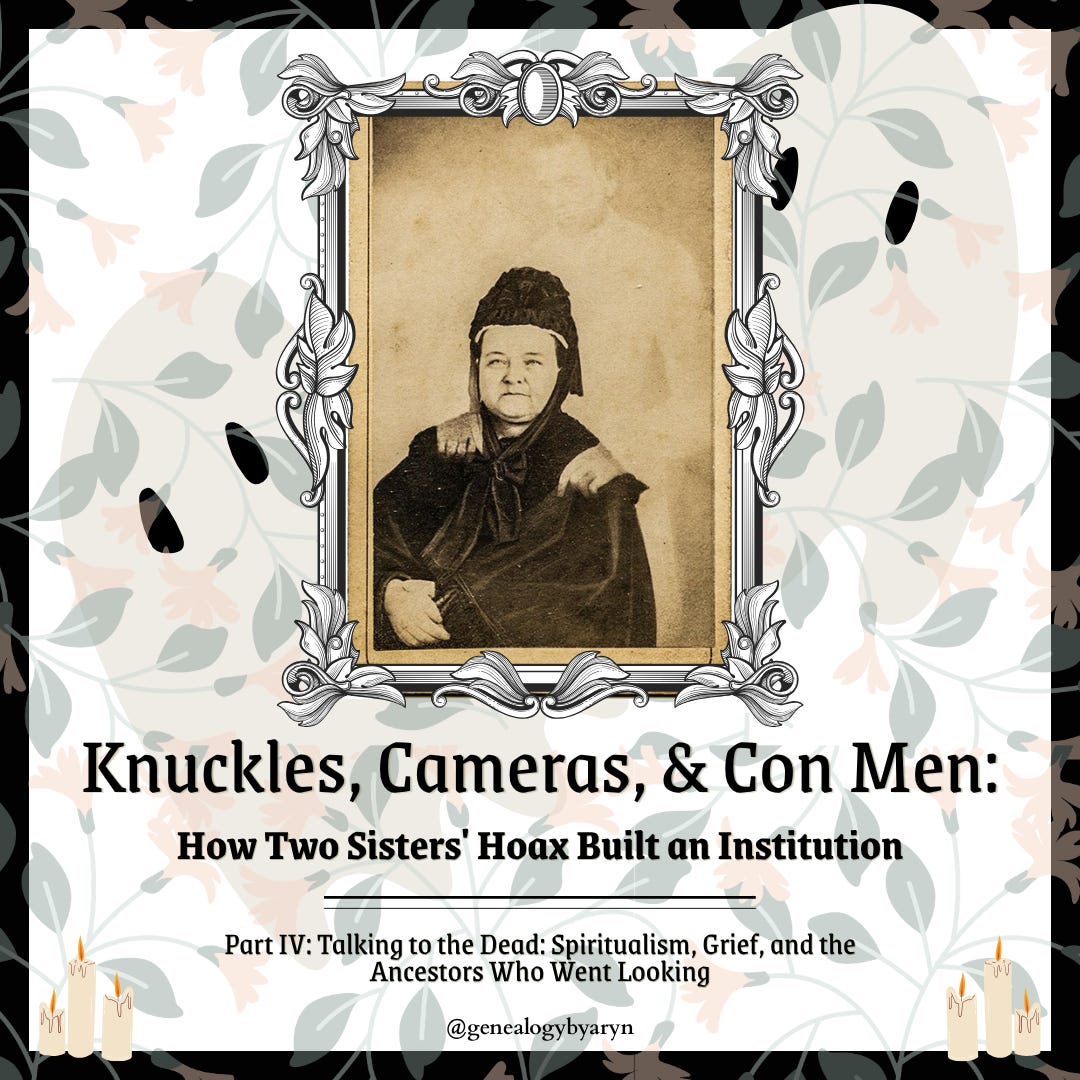
Before their confession, and while the Fox sisters were still touring, Spiritualism took a new turn. A Boston engraver-turned-photographer named William Mumler discovered something strange in a 1862 self-portrait: a faint second figure, which he identified as the ghost of his deceased cousin.3 (A nameless cousin…)
But names didn’t matter, only the photos did. The sheer amazement of Mumler’s discovery brought him the audience he needed to build an entire practice around what became known as spirit photography. When Spiritualism spiked after the tragedy of the Civil War, Mumler was there, producing images for his grieving Civil War-era clients. With each click, lo and behold, the image of a loved one appeared in a wispy, smoky form standing just behind the sitter. Each photograph did exactly what Mumler had caught with a little luck and a lot of happenstance: the untimely departed loved one standing just behind them.
His talent became the talk of all the best spiritualist circles, which led to his most famous image. That of none other than Mary Todd Lincoln, photographed with the faint form of her husband, Abe.


Not surprisingly, suspicion followed Mumler from Boston to New York, where he was arrested and tried for fraud in 1869. Showman P. T. Barnum testified against him, which says a lot, if you know anything about Barnum…4

My guess is that Barnum was likely a little miffed he hadn’t come up with the con first.5 Which was his angle at trial. He arrived with one of Mumler’s rival photographers and commissioned him to produce an equally convincing fake spirit photograph as proof of how easily the trick could be done.
Barnum got his Huge Jackman Musical and Mumler was ultimately acquitted, but his reputation never recovered. No musical for him. Instead, his trial became a template used decades later in the investigations of Mina “Margery” Crandon—psychic extraordinaire! Mumler got Barnum, and Cardon got none other than Harry Houdini. His expert testimony and reproducible technique, deployed in public against a claim of the supernatural.
This appeared in the pages of the local and national news. Below is page 9 of the Des Moines Tribune Capital: January 11, 1929.

One Door Closes, Another Opens (Spiritualism Builds Itself a Town)
Even as individual mediums were being exposed, the broader movement was institutionalizing.6 To this day, the truth is, we all want to believe that when our loved ones leave this world, they are still with us. We want to hear the knocks, see the smoky images, and maybe find a penny or two to remind us they are nearby.7
This is why, in 1879, Spiritualists founded a permanent camp community beside Cassadaga Lake in western New York—renamed Lily Dale in 1906—which remains the world’s oldest and largest Spiritualist community to this day.
This site is extra extraordinary because the original Fox family cottage was relocated there in 1916. Making it the perfect site.
The National Spiritualist Association of Churches was founded in 1893 and headquartered at Lily Dale,8 and the community’s Marion H. Skidmore Library still holds one of the world’s largest surviving collections of Spiritualist periodicals, registers, and ephemera.
This is the genealogical payoff of this particular era, and a resource we may simply overlook because we don’t realize it exists in the first place.
Unlike the witch-hunt centuries, which destroyed records as a matter of course,9 this phase of Spiritualism generated them: camp registers, congregational rolls, newspaper mastheads, association records. The best part? Many of those records survive intact.
Checklist: Records From the Institutional Era
Search the Marion H. Skidmore Library and Lily Dale Museum records for a family surname.
Check whether your ancestor’s town hosted a Spiritualist camp meeting — many operated on a similar model to religious revivals or Chautauquas.
Look for National Spiritualist Association of Churches (est. 1893) congregational records.
If a family photograph shows an unexplained faint figure or double exposure, research studio conventions of the era before assuming anything supernatural — Victorian photography had plenty of ordinary technical explanations that mediums like Mumler exploited.
Coming Next
Part V: I’ve Got Her, All Fraud — a friendship between a Sherlock Holmes author and the world’s greatest escape artist, wrecked entirely over whether the dead could talk.
Because one short paragraph about Mina “Margery” Crandon really isn’t enough.
Did you miss them?
Knock Once for Yes

When people think of Spiritualism, they usually picture the tail end of it. They see the Ouija board, a dusty velvet covered shady parlor trick, or maybe even the infamous Mina “Margery” Crandon and …
A Platform for All

Ask most people what connects the birth of women’s suffrage to a séance table, and you’ll get a blank look. But there is a connection. A big one. One worth noting, especially when you’re researching …
Speaking to the Dead: How the Civil War Fueled America's Spiritualism Movement

The Civil War killed somewhere between 620,000 and 750,000 Americans. In 1865, that was roughly 2% of the entire population of the United States. Many of them, both men and some women, died far from …

Hey! Thanks for making it all the way to the bottom!
See you next week!!

"When a 19th-Century 'Spirit Photographer' Claimed to Capture Ghosts Through His Lens." HISTORY - Side comment: Photography and the Civil War had a very unique relationship. It is important to remember that when you see photos of Civil War Battle deaths, photographers often staged them for maximum impact.
"William H. Mumler." Wikipedia — always remember to check the References Section of Wikipedia articles. Lots of good stuff there to check out.
I’m being a little sassy, but I’m not a fan of P.T. Barnum. Barnum had a lot of money and people with a lot of money tend to (try) to write their histories. Try being the key word.
For my family, it’s birds. They are the spirits of our loved ones stopping by to say hello.
Here is another Lily Dale resource: "Lily Dale (Spiritualist Assembly)." Encyclopedia.com
It’s much harder to get caught killing ladies for their land if you happen to destroy all the documentation surrounding the “fair” trial.
Part III got me thinking about military loss, coping, and Spiritualism. Part IV: Even with all that public doubt, the movement kept growing. That makes me wonder whether military wives at forts or camps ever hosted sittings or worked as mediums to earn their own money, or whether Spiritualism was more of a social activity or entertainment within those military communities, especially in remote areas. You've given me a few other avenues to consider in my own research. Great read, and thank you!
The Fox sisters were certainly an interesting phenomenon. I had no idea how Spiritualism began or that they had a site at Cassadaga Lake in New York - similar to the Shakers in New Gloucester, Maine.