


When people think of Spiritualism, they usually picture the tail end of it. They see the Ouija board, a dusty velvet covered shady parlor trick, or maybe even the infamous Mina “Margery” Crandon and her ectoplasm. But like I said, that was the ending years of the movement. When it began nearly 75 years earlier, it wasn’t a sideshow.
It started as a genuine religious upheaval.
One that, at its height, claimed one to two million American believers in its ranks, in a country that hadn’t even reached thirty million people in its total population.
If a movement that size touched your ancestors, and there’s a decent chance it did, it probably didn’t leave a note in the family Bible or an ancestral photograph tucked in the same onion skin pages. It left something quieter: a name in a newspaper column, a subscription to the wrong magazine, or perhaps a summer spent two hours from Buffalo.
The Night Hydesville Started Talking
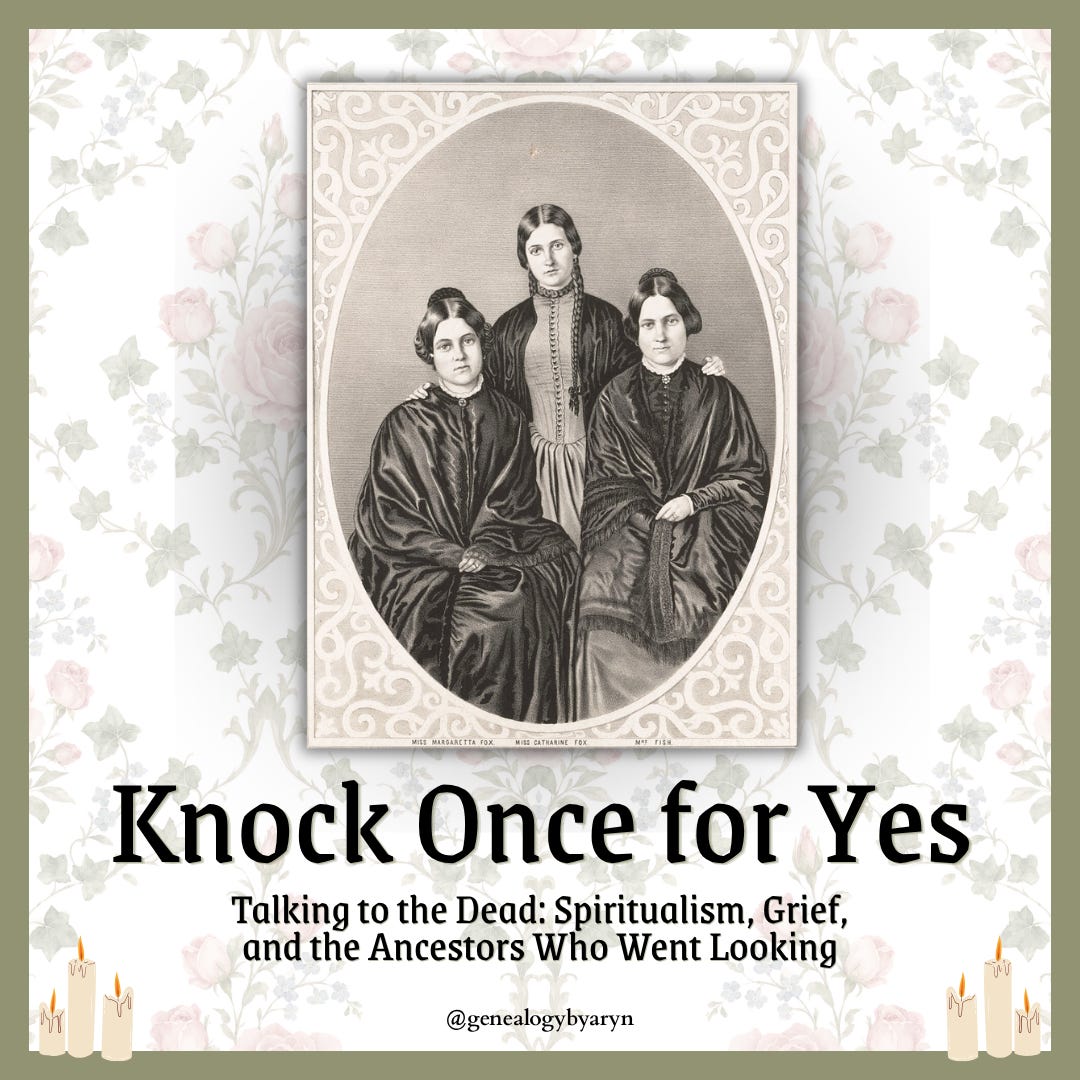
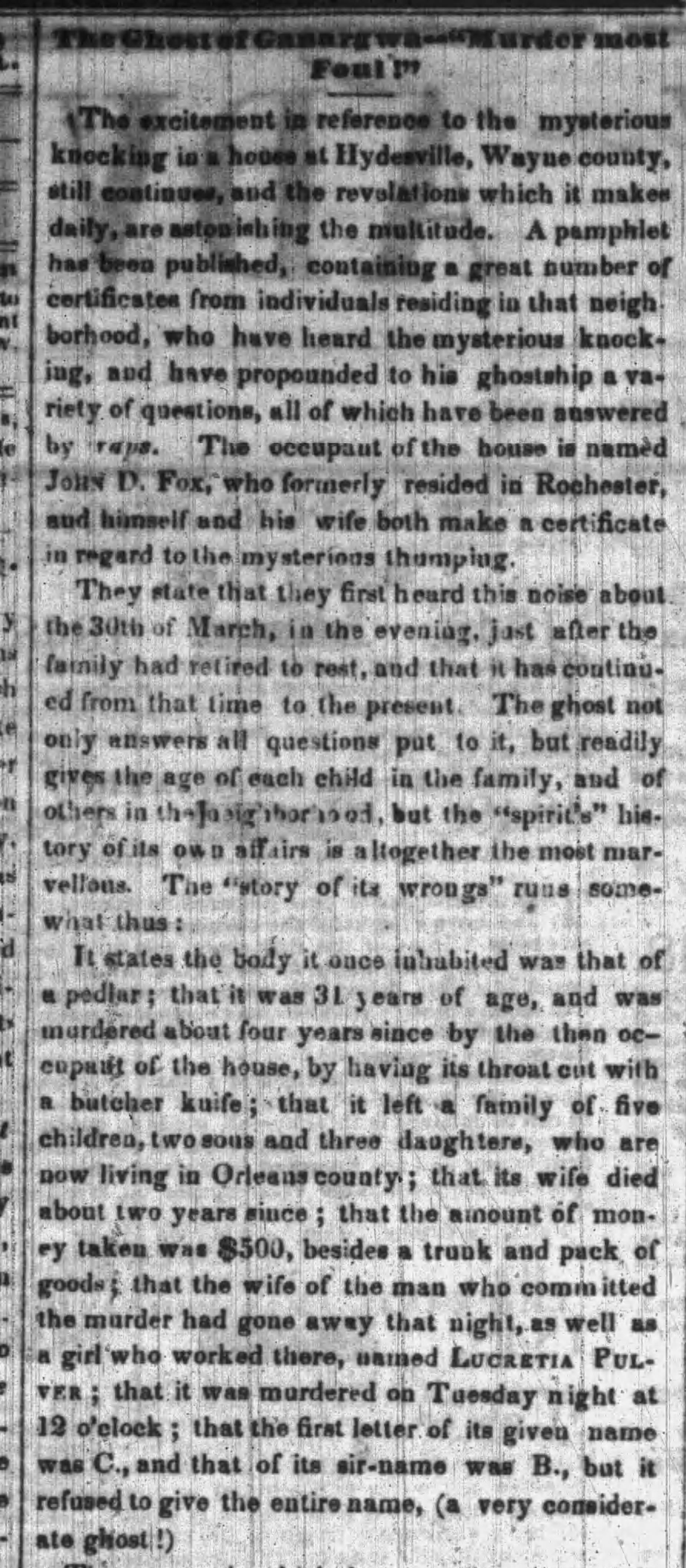
In March 1848, in a small rented cottage in Hydesville, New York, two teenage sisters, Maggie and Kate Fox, began reporting strange knocking sounds in their family’s home. The girls claimed the raps were coming from the spirit of a murdered peddler, communicating through a simple code: one knock for no, two for yes. Then they expanded the test by attempting to acquire names in a similar manner: the girls would say the alphabet and the ghost would rap on the correct letter. By the end of their encounter, they had learned a great deal about the slain peddler (age - 31, married - yes, father of 5 children, 2 sons and 3 daughters) and even that his wife had later passed, joining him in the afterlife.
While Maggie and Kate, along with their older sister Leah, claimed the spotlight – in 1848, Mr. John and Mrs. Margaret Fox also bore witness to the raps, as did many neighbors living within hearing range.
Leah, already living apart from the family, quickly stepped in to manage and publicize the Fox Sisters’ newly found gift for speaking with the dead, and before they knew it, their story had reached well beyond the boundaries containing Hydesville, New York, and people miles away heard the amazing and intriguing stories that would later become known as the Rochester Rappings.
Like wildfire, their fame grew, and within months, the sisters were touring and demonstrating their abilities to paying crowds.


The Reformers Who Made It Respectable
Like all things, their rise to fame wasn’t formed in a vacuum. The Fox sisters didn’t build their following alone, which is where things actually get interesting, at least, in my humble opinion. While Leah began the process of finding an audience for her younger sisters, it was when Amy and Isaac Post, Rochester Quakers who were deeply involved in the abolitionist and early women’s rights movements, stepped up to mentor them that things really began to escalate. With their connections, the Posts became some of Spiritualism’s first committed converts. This was the earliest alliance to matter because it meant that Spiritualism launched not as a fringe curiosity but as a movement with instant credibility among reformers who already distrusted established religious authority. These were the same people organizing against slavery (Amy was a founding member of the New York Western Anti-Slavery Society in 1842) and for women’s rights and legal standing (at the first Women’s Rights Convention in 1848 where Amy, along with other women, spoke freely about the Declaration of Sentiments, alongside Elizabeth Cady Stanton).
To Amy and her equally progressive husband, Issac, the overlap between “talking to the dead” and “fighting for the living” was one and the same. So, when we look back at the Spiritualist Movement, it’s important to remember that the overlap there was from the start, not something added 50 years after the first rap.
How Big, How Fast
The numbers are easy to underestimate. By 1854, Spiritualists themselves estimated their American following at one to two million people - roughly five to eight percent of the total population of the US at that time. Researchers tracking Spiritualist periodicals like the Banner of Light and the Spiritual Telegraph have documented activity in nearly 800 American cities during this early boom, with the heaviest concentrations in seven states: Massachusetts, New York, Ohio, Maine, Illinois, Connecticut, and Michigan.
A national organization of Spiritualists had already formed by 1864, barely sixteen years after two girls in a farmhouse claimed to hear knocking.

What This Means for Your Tree
Most genealogical evidence of an ordinary Spiritualist ancestor won’t be a diary entry that says “I believe in ghosts.” It will be circumstantial at best, like a location, a social circle, or a gap in the record where a more conventional religious affiliation should be.
If you suspect you may have had an ancestor who joined the spiritual movement from the start, here is where to start looking.
Checklist: Was Your Ancestor Living Through the Rappings?
Did they live in Massachusetts, New York, Ohio, Maine, Illinois, Connecticut, or Michigan between 1848 and the 1870s?
Were they part of a Quaker, Unitarian, or abolitionist social circle?
Is there a family story about a grandmother or great-aunt who had “the gift” or “second sight” that traces back to this era?
Do you have an unexplained gap in a female ancestor’s religious or social record right around 1848–1860?
Have you searched digitized local newspapers for her surname alongside words like “rapping,” “medium,” or “circle”? Papers covered Spiritualism heavily, even when they were mocking it.
Coming Next
Part II: A Free Platform for All — how the same movement that let a farmhouse rapping become a national religion also helped put the first woman on a presidential ballot.
Have you been working on your family history and considering transforming it into a narrative?
Check out The Genealogy Storytellers Virtual Summit - September 18th - 19th. To learn more, follow the link below:

I read Part 3 first, and now I’m going back for Parts 1 and 2.
I’ve always been interested in Spiritualism, but I’ve never really pursued researching it. I had mostly thought about it through the lens of séances and mediums, so seeing it as a much broader religious and social movement is very interesting.
I never really thought about Spiritualism in terms of, “How might this show up in your family history?” which gives me more to think about with my own family history.
Looking forward to Part II!
An interesting read. Looking forward to the next installment.