


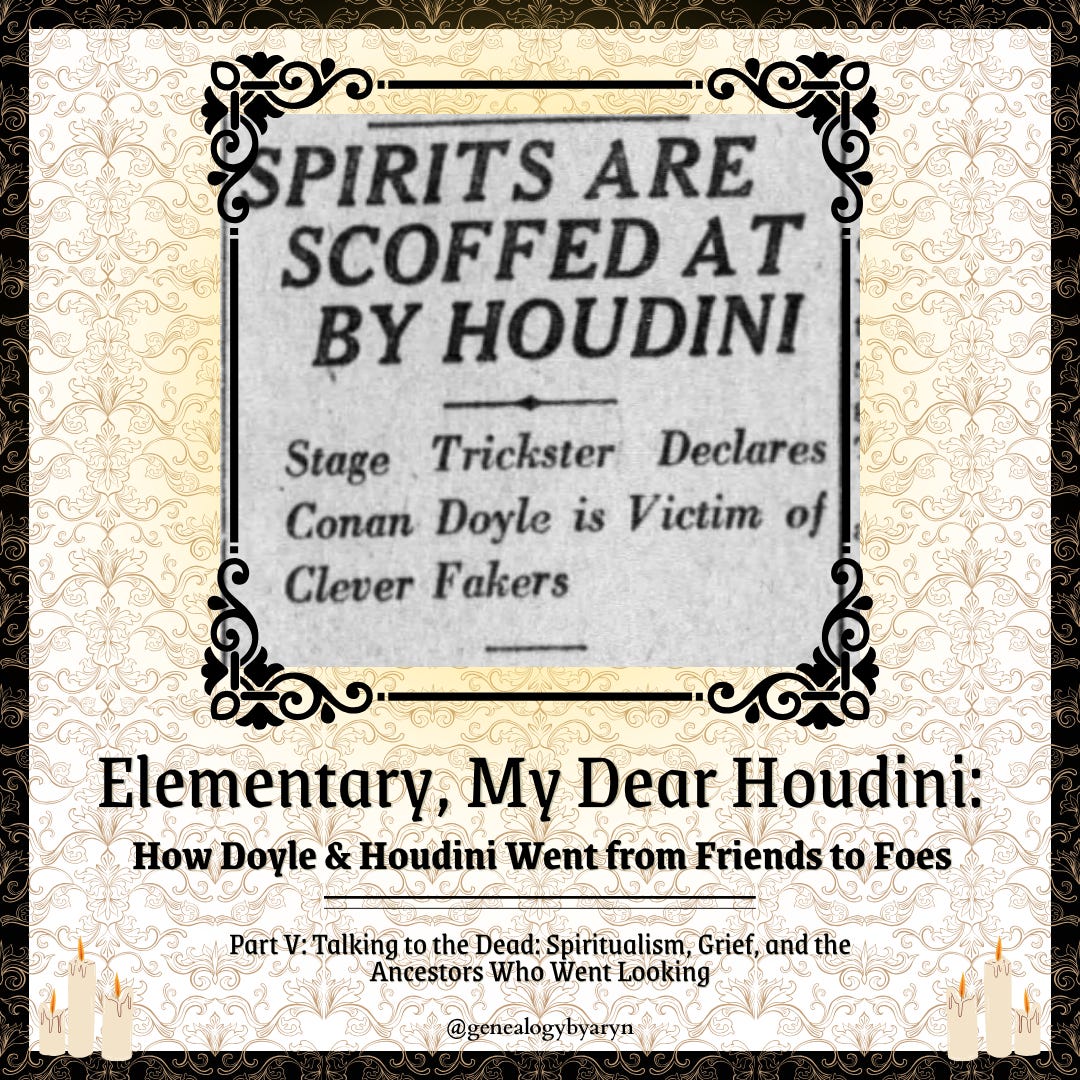
World War I claimed the lives of roughly twenty million people worldwide.
Like the American Civil War, World War I became a new source of fuel for the Spiritualism movement. It took the previous fifty years of transformation and evolved the movement to fit the new 20th Century. Just as the American Civil War created a platform for people to use the Spiritualist movement for purposes other than, well, spirituality, World War I also shaped space for newcomers looking to reconnect with loved ones taken by the Great War.
But this period also did something the American Civil War period hadn’t done: it produced one of the strangest celebrity friendships of the twentieth century and one of its ugliest public feuds.
And both were built on the exact same question this whole series has been circling: can the dead still communicate with the living?
A Father’s Grief, A Convert Made
You may know him as the inventor of Sherlock Holmes, but Sir Arthur Conan Doyle also spent a good portion of his adult life dabbling in the research of psychics and haunted locations since the 1880s and 90s. His interests caught the attention of the Society for Psychical Research. So, in January of 1893, the Society extended him an invitation to join, and in February of that same year, he did. Yes, Sir Aruthor Conan Doyle was a Victorian-era paranormal researcher. Along with his Society brethren, he investigated reportedly haunted houses.
Doyle’s very famous Sherlock Holmes hit the shelves in December of 1887, but it wasn’t novel research that pulled him into the folds of the Spiritualist movement. Like so many others who came before him, and would proceed him, his interest in the existence of psychics and ghosts was personal. In 1918, personal loss turned him from curious investigator into full evangelist: his son, Arthur Alleyne Kingsley Conan Doyle, better known simply as Kingsley, died.
Kingsley was wounded in the Battle of the Somme, from which he recovered. He was sent home in May 1918 to continue his medical studies, which he had paused to join the Great War. But Kingsley contracted pneumonia, a complication of the 1918 Flu Pandemic that followed the conclusion of World War I.

He died on 28 October 1918 at only twenty-five. The man who spent his lifetime writing books with a main character who only entertained the ideas of pure logic was said to have attended a séance within days of Kingsley’s passing. It wasn’t long before Doyle came to believe he had since communicated with his departed son through mediums.
From that point on, Sir Arthur Conan Doyle spent much of his remaining fame and fortune lecturing and publishing in open, public support of Spiritualism as a legitimate religion. His nonfiction book, The Wanderings of a Spiritualist, is available to read (for free) on the HathiTrust website, but my personal favorite nonfiction title by Doyle was The Coming of the Fairies, published in 1922—where he openly defended the authenticity of the Cottingley Fairies.
The fairy photos were later debunked by the very girls who had taken them: Elsie Wright and Frances Griffiths.
But that is a whole other story.

The Skeptic and the True Believer
Sir Arthur Conan Doyle wasn’t the only contemporary celebrity to get caught up in the Spiritist movement. Harry Houdini was in the “are ghosts real?” trenches as well. So, in 1920, Doyle and Houdini met and struck up an unlikely friendship built on a shared fascination with the unexplained.
But, to be clear, while the friendship was real, unlike Doyle, Houdini remained a committed skeptic who had spent much of his post-magic career exposing fraudulent mediums. Yet both Doyle and Houdini enjoyed writing letters, back and forth, discussing the possibility of spirits. Were they real? Did Doyle really reach Kingsley? And, on Doyle's side, he actually wondered if the greatest magician of ALL time was, in fact, a medium himself.
Regardless of what Doyle thought, Houdini made it clear that he was not in communication with any ghosts. He was simply a talented illusionist.
While Houdini enjoyed his time with Doyle, he also held onto his skepticism. After all, he had become famous at convincing people they had seen something that simply wasn’t true.

In April 1920, Doyle and Houdini finally met face-to-face, and they maintained their friendship for the next few years.
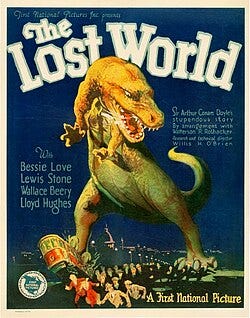
At first, the friendship was just that, friendly, and in 1922, Doyle famously pranked the Society of American Magicians—whom Houdini was a member of—by screening early stop-motion dinosaur footage from his novel The Lost World with its special effects created by Willis O’Brien. Doyle refused to explain how he'd done it, and he let the room wonder whether something stranger than trick photography was involved.
But the friendship didn’t survive much longer after the prank.
At a private séance in Atlantic City, Doyle’s wife, acting as an automatic-writing medium, produced a message she said came from Houdini’s beloved late mother, written in fluent English, opening with a Christian cross.
The problem was that Houdini’s mother had been a rabbi's wife and spoke almost no English in her lifetime. Houdini published a public rebuttal pointing out exactly that discrepancy, and the friendship broke apart in the press.

The Public War
What followed was a running, years-long feud conducted through lectures, pamphlets, and newspaper columns.
Doyle pushed for Spiritualism to be recognized as an official religion.
At Doyle’s urging, Scientific American offered a $2,500 prize in 1924 to any medium who could demonstrate genuine physical phenomena under controlled scientific conditions. The front runner of the competition was none other than Mina “Margery” Crandon.
The same Mina “Margery” Crandon Harry Houdini devoted time to disclose nothing but a fraud in October of 1924—thus knocking her out of the running for the $2,500 prize.
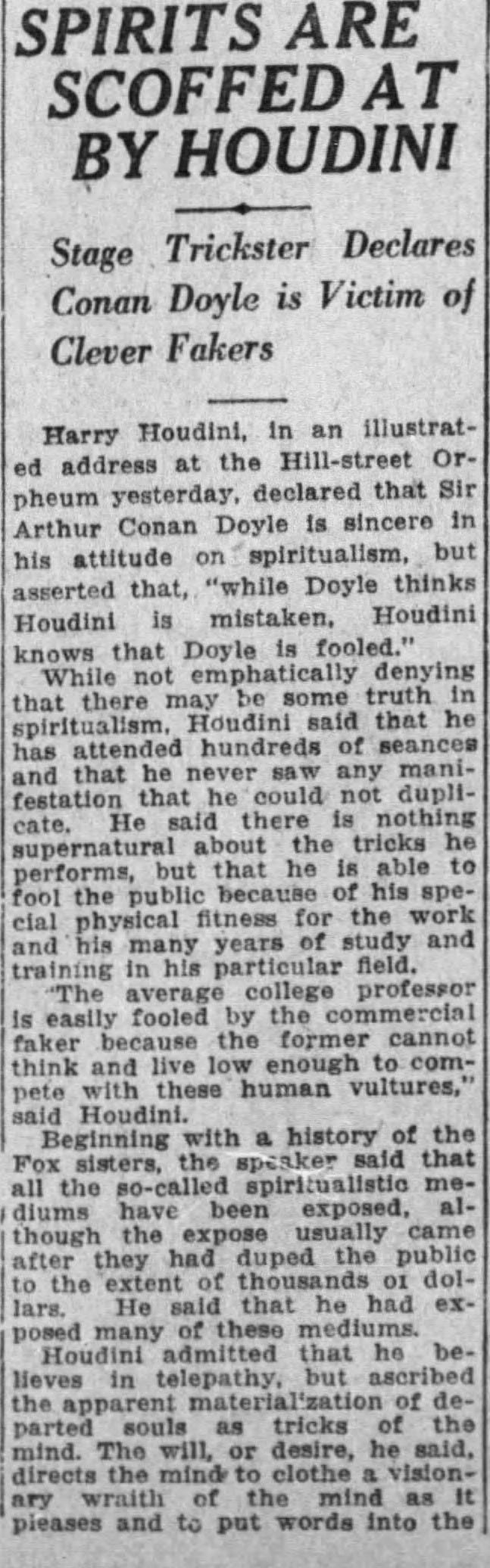
Houdini toured the country exposing mediums and eventually testified before Congress for four days in February 1926 about fraud in the field, at one point calling Doyle one of the greatest dupes he had ever known.

Doyle never forgave Houdini for what he saw as a betrayal. After all was said and done with the unfortunate death of Houdini’s on Halloween 1926, Doyle continued writing about his one-time friend. Even though, until his last breath, Harry Houdini was loud about his skepticism, Doyle was still convinced some of Houdini’s famous escapes had been genuinely supernatural.
Checklist: Weighing Celebrity and Institutional Endorsement
If a family story involves a famous relative, investigator, or newspaper feud, trace it back to a primary account rather than accepting the secondhand version.
If an ancestor participated in a “test” séance or a formal investigation of a medium, search by the investigator’s name as well as the medium’s — local papers often covered both.
Remember that public feuds like this one generated enormous documentation. If an ancestor attended a Doyle lecture or a Houdini demonstration, local papers sometimes printed attendee lists or detailed reviews.
Coming Next
The final chapter: Part VI: The Most Tested Medium — how the Scientific American prize this feud created led straight to Mina “Margery” Crandon’s Boston séance room, and the end of Spiritualism’s long run at the center of American life.
Did you miss it?
Knock Once for Yes

When people think of Spiritualism, they usually picture the tail end of it. They see the Ouija board, a dusty velvet covered shady parlor trick, or maybe even the infamous Mina “Margery” Crandon and …
A Platform for All

Ask most people what connects the birth of women’s suffrage to a séance table, and you’ll get a blank look. But there is a connection. A big one. One worth noting, especially when you’re researching …
Speaking to the Dead: How the Civil War Fueled America's Spiritualism Movement

The Civil War killed somewhere between 620,000 and 750,000 Americans. In 1865, that was roughly 2% of the entire population of the United States. Many of them, both men and some women, died far from …
Knuckles, Cameras, and Con Men: How Two Sisters' Hoax Built an Institution

Every movement eventually has to answer for itself. For the witch hunts, that reckoning came slowly, through trial records and confiscated property, centuries later. Last year, I spoke more about the…
What is a ghost anyway?

I’ve spent the last few weeks discussing the Spiritual Movement. While the ideas of ghosts lived long before the Fox Sisters reported a rapping on their cabin wall, and I suspect those beliefs will o…

I found this quite interesting. Thanks for all your hard work :)
What keeps catching my attention in this series is the searching, the questions, and the need to feel that a connection hasn’t entirely disappeared. Military and family records might tell us when someone died, sometimes without explaining exactly how. But they rarely tell us how the family tried to live with that loss. And here, Doyle and Houdini were asking the same question while disagreeing over what would count as an answer. That’s quite a fault line for a friendship.